
Tonga
Last updated: 16 April 2026
At a glance
The Kingdom of Tonga is a Polynesian archipelago of 171 islands scattered across roughly 700,000 square kilometres of the southern Pacific Ocean, of which 45 are inhabited. The country stretches approximately 800 kilometres north to south and is organised into four main island groups: Tongatapu in the south, Ha'apai in the centre, Vava'u in the north, and the remote Niuas at the northern extreme. Total land area is modest at around 750 square kilometres, but the cruising ground is vast. About 70 percent of the population of approximately 107,000 lives on Tongatapu, the southernmost and largest island, which is also home to the capital, Nuku'alofa.
Tonga is the only sovereign monarchy in the Pacific and one of the few countries in the region never to have been colonised. The constitutional reforms of 2010 introduced a partially elected parliament, though the monarchy retains significant influence. Christianity is the state religion and shapes daily life in ways visitors notice quickly: Sundays are a complete day of rest, with shops and services closed and restrictions on noise and activity that extend to vessels at anchor. English is widely spoken alongside Tongan.
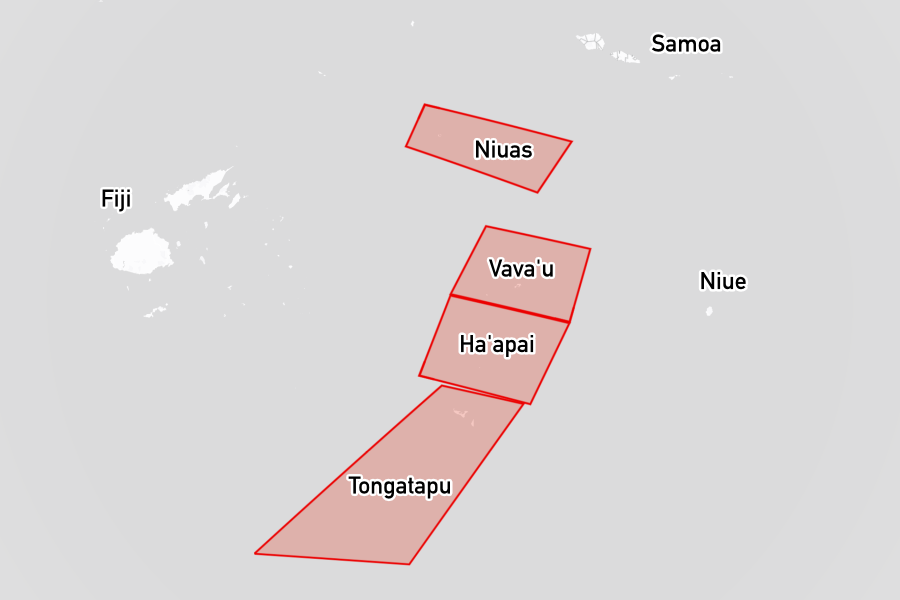
Explore sailing areas
Our sailing area guides contain the most useful information for cruisers, including top-rated places to stay, attractions, yacht services, and summaries of yacht clearance experiences.
- Vavaʻu Group (Northern Tonga) Popular for its sheltered bays and well-established yacht services.
- Haʻapai Group (Central Tonga) Visited for remote anchorages and pristine marine environments.
- Tongatapu Group (Southern Tonga) Houses the capital and offers historical exploration opportunities.
- Niuas (Far North Tonga) Appeals to those seeking less frequented cruising territories.
Yacht clearance and notes for mariners
See the relevant sailing area page above for details.
The off-season
Tonga's cyclone season runs officially from 1 December to 30 April, with the peak period of tropical activity concentrated between mid-January and mid-March. Most cruising yachts depart for New Zealand or Fiji before December, with mid- to late November widely regarded as the preferred departure window. Minerva Reef, approximately 250 nautical miles southwest of Vava'u, is a common staging point on the passage south.
Those who remain through the season typically do so in Vava'u, where haulout facilities and cyclone moorings are available. Nuku'alofa, by contrast, has no haulout facilities and is exposed, making it an uncommon choice for extended stays. Storm tracks tend to pass to the southwest of the island group, and some yacht services in Vava'u continue to operate year-round. Cruising traffic thins considerably after late October, but the period through November is considered by many to offer some of the best sailing conditions of the year. The return passage from New Zealand typically begins from mid-May onward, once the trade winds have re-established.
Facts for visitors
- Best times of year to sail: April to December, with the main season coinciding with the humpback whale season from July to October
- Shore power: 220V, 50Hz (Australian/New Zealand plug type)
- Provisioning cost: Medium
- Currency: Tongan Pa'anga (TOP). Very few establishments accept foreign currency or credit cards; cash is essential. ATMs are available in Neiafu and Nuku'alofa
- Personal security: Tonga is generally a low-risk destination. Normal precautions apply. Nudity is prohibited by law and can result in prosecution; this applies on board if visible from shore. Displaying anger or public intoxication is considered seriously antisocial.
- Emergency phone numbers:
- Fire: 911 / 70699 (Vava'u)
- Police: 922 / 70233 (Vava'u)
- Hospital: 933 / 70201 (Vava'u)
- International dialling code: +676
- Time zone: UTC+13 (no daylight saving). Note that crossing from the Cook Islands or Samoa involves crossing the International Date Line.
Maritime history
The islands now known as Tonga were first settled approximately 2,500 years ago by the Lapita civilisation, a seafaring culture whose navigational range spanned much of the western Pacific. From this foundation, a distinct Tongan identity and language emerged, and by the medieval period the islands had become the seat of a regional maritime empire. The Tu'i Tonga dynasty, which tradition traces to a founding king named 'Aho'eitu, extended Tonga's influence across an extraordinary arc of the Pacific, from parts of the Solomon Islands and Fiji in the west to Samoa, Niue, and into what is now French Polynesia in the east. This thalassocracy was sustained not by military force alone but by an elaborate system of economic exchange and cultural prestige that maintained Tongan authority for centuries.
European contact began in 1616 when the Dutch navigators Willem Schouten and Jacob Le Maire sighted the northern islands. Abel Tasman made more substantive contact in 1643, and it was James Cook's three visits between 1773 and 1777 that brought Tonga to sustained European attention. Cook named the group the Friendly Islands, reportedly on account of the hospitable reception he received, though his journals also record tensions that later historians have attributed to ambivalent Tongan attitudes toward the visitors. Cook anchored at multiple points across the archipelago, and several of his anchorages in the Ha'apai group remain recognisable landmarks for cruising sailors today.
The early nineteenth century brought more turbulent encounters. In 1806, the British privateer Port au Prince was attacked and burned in the Ha'apai group, an event that became widely known through the account of William Mariner, a fourteen-year-old crew member who was spared and spent four years living among the Tongans before returning to England. His subsequent memoir, published in 1817, provided one of the most detailed early records of Tongan society. The same period saw the Bounty pass through Tongan waters: William Bligh watered at Nomuka in the Ha'apai shortly before the mutiny of April 1789.
Christian missionaries arrived in force from the 1820s, with Wesleyan influence becoming dominant by mid-century. The kingdom was consolidated under King George Tupou I, who unified the island groups, codified laws, and formalised a constitutional monarchy in 1875. Tonga entered a British protected-state arrangement in 1900, under which the UK managed foreign affairs but Tonga retained its sovereignty, a distinction the kingdom maintained with some pride. Full independence was restored in 1970, and Tonga joined the Commonwealth shortly thereafter. In January 2022, the Hunga Tonga-Hunga Ha'apai submarine volcano erupted north of Tongatapu, generating a tsunami that caused widespread damage across the archipelago and briefly severed all external communications.