
Greece
Last updated: 7 April 2026
At a glance
Greece offers one of the most extensive cruising grounds in the Mediterranean, with a coastline and island network spanning from the Ionian Sea in the west to the Aegean in the east. Ten principal cruising areas range from sheltered island chains such as the Ionian Islands and Sporades to more exposed passages across the open Aegean, with the Cyclades and Dodecanese offering island-hopping routes that extend close to the Turkish coast. The Peloponnese bridges the two seas, while Crete forms the southern boundary of the Aegean basin. Infrastructure ranges from well-developed marina hubs to remote anchorages with no facilities.
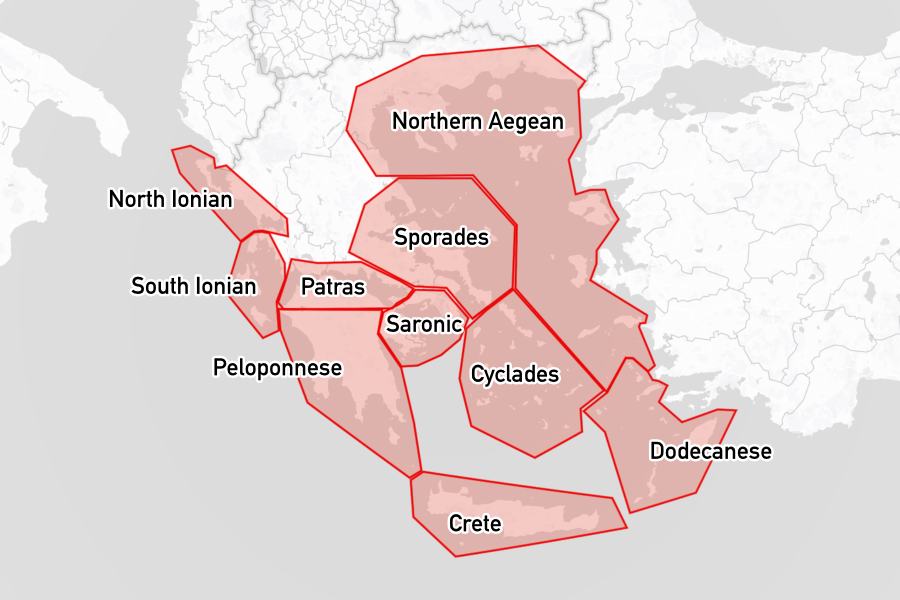
Explore sailing areas
Our sailing area guides contain the most useful information for cruisers, including top-rated places to stay, attractions, yacht services, and summaries of yacht clearance experiences.
- The North Ionian Attracts sailors for its calm waters and picturesque islands with abundant shelter.
- The South Ionian Offers safe harbours and a rich cultural heritage among coastal towns and islands.
- The Gulf of Corinth Features historical sites and convenient access to mainland destinations.
- The Saronic Gulf Close proximity to Athens makes it popular for weekend cruising and yacht services.
- The Peloponnese Rich in history and diverse landscapes, with various ports and bays to explore.
- The North Aegean Known for lively towns and charming islands with a sense of tradition.
- The Sporades Popular for its lush scenery and tranquil anchorages for resting sailors.
- The Cyclades Famous for its unique architecture and vibrant local culture among island groups.
- The Dodecanese Offers a blend of rich history and varied landscapes across its islands.
- Crete Provides a wealth of historical sites and diverse sailing opportunities.
Yacht clearance and notes for mariners
See the relevant sailing area page above for details.
The off-season
Greece has well-established facilities for winter storage. There are many options for living aboard too, some worth investigating are: Marina Porto Heli, Peloponnese, Kalamata Marina, Peloponnese, Messolongi, Gulf of Patras, and Preveza Marina, Ionian.
Facts for visitors
- Best times of year to sail here: May to October
- Most common type of shore power: 230V 50Hz
- Cost for provisioning: Low to Medium
- Currency: Euro (EUR)
- Personal security: Generally safe for visitors; petty theft is the most common concern in busier tourist areas
- Emergency phone numbers:
- Police: 100
- Ambulance: 166
- Fire: 199
- Coast Guard: 108
- International dialing code: +30
- Time zone: UTC+2 / UTC+3 (summer)
Calling for help
Warning: any call for assistance that is heard and logged triggers a requirement for the port police to seize boat papers and detain the vessel until a surveyor's seaworthiness certificate is obtained and the incident allocated a reference number by the Ministry of Maritime Affairs. Seaworthiness certificates carry a significant charge whether or not a physical inspection takes place. The process is triggered whenever the coast guard becomes aware of an incident, whether through a VHF call or otherwise. The Hellenic Coast Guard monitors VHF channel 12, not channel 16. Where possible, contact assistance by phone rather than VHF.
Maritime history
In the Bronze Age, the Minoans of Crete were active traders, exchanging copper, pottery, and luxury goods with Egypt and the eastern Mediterranean. They were succeeded by the Mycenaeans, a warrior culture on the Greek mainland whose ships and raiding parties ranged widely enough to leave traces in Egyptian records and, centuries later, in the epics of Homer.
After the decline of the Minoans and the later collapse of the Mycenaean world around 1200 BC, Greece became a patchwork of independent city-states, each controlling its own harbour and coastline. These were not provinces of a single country but rival powers, and maritime strength was central to their competition.
Athens built the fleet that defeated the Persian navy at the Battle of Salamis in 480 BC. After this victory it led the Delian League, a naval alliance that it dominated. The league's resources helped fund Athens' golden age. Elsewhere, cities such as Corinth and Rhodes developed their own commercial roles, while Greek trading colonies spread across the Mediterranean from the Black Sea to the coast of modern Spain.
Greek maritime commerce continued even after political independence was lost. Under Byzantine and later Ottoman rule, Greek merchants remained active across the eastern Mediterranean. Islands such as Hydra, Spetses, and Psara became wealthy trading centres. Their ships later formed the core of the fleets that played a decisive role in the Greek War of Independence in the 1820s.
After independence, Greek shipowners quickly adopted steam propulsion and were trading worldwide by the late nineteenth century. Both world wars brought heavy losses, and the Second World War destroyed roughly 70 percent of the Greek merchant fleet. Recovery began with surplus American Liberty ships purchased cheaply after the war. In the decades that followed, shipowners such as Aristotle Onassis and Stavros Niarchos drove a major expansion in tanker shipping. Today Greece controls around 21 percent of the world's merchant fleet by tonnage, the largest share of any single nation.