
Spain
Last updated: 11 April 2026
At a glance
Spain divides into four cruising areas: the Mediterranean coast, the Balearic Islands, the Canary Islands, and the northern coast along the Bay of Biscay. The Mediterranean coast and Balearics are well served by marina infrastructure and benefit from reliable summer conditions. The Canary Islands, an Atlantic archipelago some 1,000NM from mainland Spain, have excellent yachting facilities and serve as a major staging point for Atlantic crossings. The northern coast has a distinct character and ranges from the Rias in the west across to the border with France in the east.
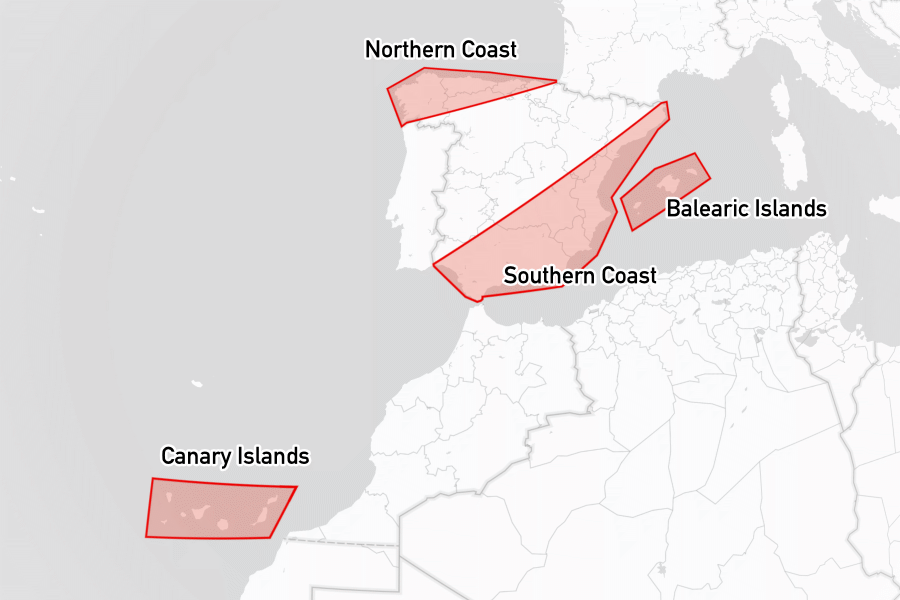
Explore sailing areas
Our sailing area guides contain the most useful information for cruisers, including top-rated places to stay, attractions, yacht services, and summaries of yacht clearance experiences.
- Northern Spain Sheltered rías and a key Biscay staging port along a rugged Atlantic coast.
- Southern Spain Connects the Atlantic Ocean, with historic ports and routes of Mediterranean Spain.
- Balearic Islands Attracts yachts with clear-water anchorages, limestone calas, and lively island towns.
- Canary Islands A major Atlantic staging point with volcanic landscapes and year-round sailing conditions.
Yacht clearance and notes for mariners
See the relevant sailing area page above for details.
The off-season
Many Spanish marinas offer haul-out and storage for the off-season. Some marinas suitable for those wishing to live aboard include: Yacht Port Cartagena, Almerimar, Port Ginesta in Spain, Tangier in Morocco, and Marina de Lagos in Portugal. Those based in the Canary Islands over winter might consider Marina de Las Palmas on Gran Canaria.
Facts for visitors
- Best times of year to sail here: May to October on the Mediterranean coast and Balearics; year-round in the Canary Islands
- Most common type of shore power: 230V 50Hz
- Cost for provisioning: Medium
- Currency: Euro (EUR)
- Personal security: Generally safe for visitors, with petty theft the main concern in tourist areas
- Emergency phone numbers:
- Police: 112
- Ambulance: 112
- Fire: 112
- Coast Guard (Salvamento Marítimo): 112
- International dialing code: +34
- Time zone(s): UTC+1 (UTC+2 in summer) mainland and Balearics; UTC+0 (UTC+1 in summer) in the Canary Islands
Maritime history
Coastal trade along the Iberian peninsula dates to Phoenician settlements established around the 9th century BC, with Greek and later Roman colonists expanding the network of ports across Spain. Under Roman rule, Carthago Nova (Cartagena) and Gades (Cádiz) became significant export hubs for minerals, olive oil, and grain.
Arab forces crossed from North Africa in AD 711, and Moorish rulers maintained active maritime trade across the western Mediterranean for centuries. The architectural legacy of this period remains visible in coastal towns throughout the south, most notably in Málaga and Almería. The Christian reconquest of the peninsula, completed in 1492 with the fall of Granada, coincided with the first Spanish-sponsored Atlantic voyages. Columbus's crossing to the Americas that same year, departing from Palos de la Frontera, established trade routes that sustained the Spanish empire for three centuries, with Seville and later Cádiz serving as the principal ports for transatlantic commerce.
Spanish naval power reached its height in the 16th century. The defeat of the Armada sent against England in 1588 marked the beginning of a long decline, as Dutch and English rivals progressively challenged Spanish control of Atlantic sea lanes. The loss of most American colonies in the early 19th century brought the transatlantic trade system effectively to a close.
Today, Spain has a substantial commercial port network, with major facilities at Barcelona, Valencia, Algeciras, and Las Palmas. The Canary Islands remain a key waypoint on the Atlantic circuit, with Las Palmas and Tenerife among the most frequently used departure points for ocean crossings.