
Samoa
Last updated: 10 April 2026
At a glance
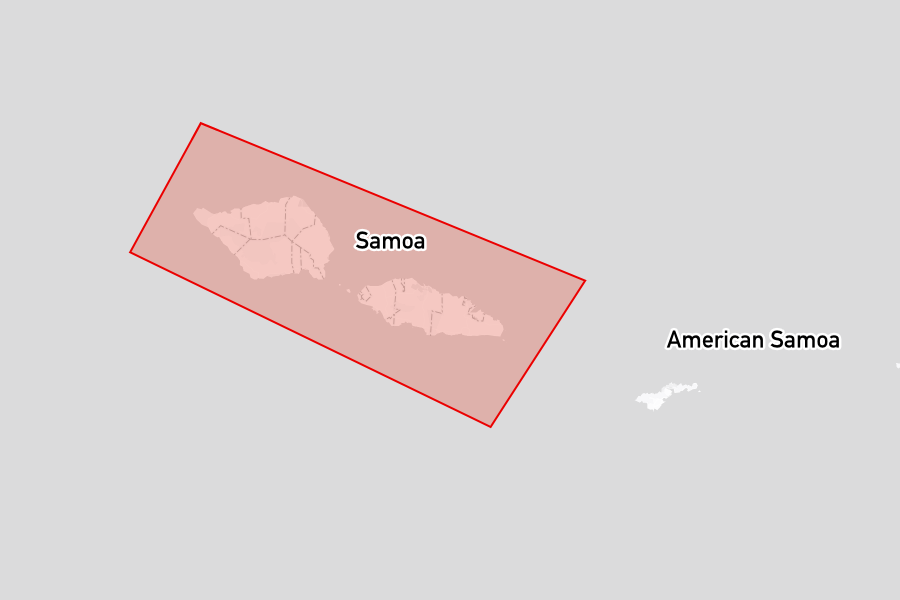
Samoa comprises two main volcanic islands, Upolu and Savai'i, along with several smaller islets, lying in the central South Pacific roughly midway between Hawaii and New Zealand. Upolu, the smaller but more populous of the two, holds the capital Apia, the country's only port of entry for yachts. Savai'i, the larger island, retains a markedly rural character. The islands are mountainous and densely forested, with a coastline of reef-fringed bays, black sand beaches, and lava fields shaped by relatively recent volcanic activity.
Samoan society is organised around the Fa'asamoa (the Samoan Way), a system of extended family groups known as aiga, each governed by an elected chief, or matai. This framework shapes village life, land ownership, and community decisions as thoroughly as any formal government institution. Christianity sits alongside it as a central pillar of daily life, and the two together give Samoan culture a distinctive cohesion that visitors encounter at every turn.
Cruising options are limited here, and claring in complicated. Most visitng yachts stop here to break a longer Pacific passage.
Attractions
In the hills south of Apia, Papaseea Sliding Rocks is a series of natural rock chutes worn smooth by water, feeding into swimming pools in a jungle setting.
To-Sua Ocean Trench, on the south coast of Upolu, is a large seawater sinkhole roughly 30 metres deep, reached by a ladder to a floating platform that rises and falls with the swell pushing in from the ocean connection below. The surrounding grounds include a lava field and coastal walking paths.
A roadside pull-off near the centre of the island looks across the valley to Papapapai Waterfall, a 100-metre drop into dense rainforest. There is no entry fee and no trail to the base.
In Apia, the Samoan Culture Village runs sessions Tuesday to Friday covering traditional weaving, cooking, tattooing, singing and dance. The food prepared during the session is served at the end.
The R.L. Stevenson Museum occupies the restored colonial house above Apia where the writer spent his final years. Guided tours cover the property and a path leads up to the hilltop graves of Stevenson and his wife. Stevenson was known to Samoans as Tusitala (teller of tales), engaged actively with local politics, and chose to be buried on Upolu. The house later served as the residence of German and New Zealand colonial administrators before its restoration.
Savai'i, accessible by ferry from the northwest tip of Upolu, is less visited and distinctly quieter. The Saleaula Lava Fields on the northeast coast preserve the ruins of a church consumed by a flow from the 1905 to 1911 eruptions of Mount Matavanu. On the west coast, Alofaaga Blowholes drive ocean swell through lava tubes with exceptional force; locals feed coconuts into the holes to demonstrate the pressure.
Sunday in Samoa operates on its own terms. Families dress formally for church, businesses close, and the sound of unaccompanied choral singing carries from congregations of every denomination across the islands.
Places to stay
Below are the most popular and highly rated places to stay, based on reviews from the noforeignland community:
Anchorages

|
Apia anchorage
★
3.7
Anchoring conditions at Apia are generally favorable with good holding in mud. Customs clearance involves extensive paperwork, and experiences vary with staff opinions and efficiency. Some officials request gifts, which merits caution when interacting.
|
Marinas

|
Apia Marina
★
4.0
A small marina with basic facilities, featuring affordable rates and reliable water supply. Visitors should be prepared for occasional surge and noise from nearby establishments. Sharon, the manager, provides helpful assistance with local logistics and customs procedures.
|
Yacht clearance links
Useful yacht clearance links:
- Noonsite: Clearance procedures, processes and fees.
- https://www.noonsite.com/place/samoa/
Yacht clearance reviews
The following lists summarize noforeignland user reviews for clearing in at ports of entry and when using clearance agents in Samoa:
Ports of entry offices
|
Apia Immigrations office
★
4.5
The immigration office is located on the first floor. Each visitor must sign their immigration form, and the office closes at 3 PM. There is no waiting period to access the service.
Place details mention: check in steps, departure requirements and official inspections.
|
|
Samoa Port Authority
★
3.7
Anchoring fees must be paid in cash at the port office. Recent visitors paid 265 to 270 Tala for anchoring, with confirmation that there is no fee when using the marina. The staff is described as helpful and accommodating.
Place details mention: fees or payments and opening hours.
|
|
Apia Customs Office
★
2.8
Visitors report a friendly atmosphere at the Apia Customs Office, but note significant inefficiencies in the process. Multiple Reviews highlight the time-consuming nature of paperwork and the need for patience. Expect a substantial time investment for clearance activities.
Place details mention: check in steps, required documents, fees or payments, opening hours and departure requirements.
|
Notes for mariners
Apia, on the north coast of Upolu, is Samoa's sole port of entry and the only yacht-clearing point in the country. Vessels must obtain a cruising permit from Apia before visiting any other harbour or anchorage in Samoan waters; the permit can be arranged on arrival at the government building in town. Clearance cannot take place on weekends, and this is worth accounting for in passage timing.
Vessels should call Apia Port Control on VHF channel 16 approximately one to two hours before arrival. Health officials board first; immigration and customs follow, and may attend separately. It is advisable to have crew lists, passports, and a declaration of provisions and biosecurity items prepared in advance. Passports are typically returned the following day from the immigration office in town. Vessels departing to other anchorages must formally clear out of Apia first, even if they intend to leave Samoan waters from elsewhere; the clearance date can be set forward to accommodate a cruising itinerary.
Biosecurity requirements are taken seriously. All food items and any plant or animal material must be declared on a Master's Declaration Form. Garbage must remain sealed aboard until disposed of under quarantine supervision. Pets are subject to a 120-day quarantine period ashore and are not permitted to land.
Samoa switched from the east side to the west side of the International Date Line in 2011. Vessels arriving from the Cook Islands or French Polynesia will lose a calendar day. American Samoa remains on the opposite side.
Savai'i's anchorages require a cruising permit and, in some cases, advance permission from Apia Port Authority. The entrance to Asau Harbour on the northwest coast is narrow, charted inaccurately on most electronic charts, and best transited in good light and at low water; satellite imagery is recommended for planning. Matautu Bay on the northeast coast is more straightforward and offers good shelter from prevailing trades. The south and west coasts of Savai'i are exposed roadstead anchorages suited to settled conditions only.
The reef-fringed north coast of Upolu has anchorages available with a cruising permit, but their protection is limited and holding in some locations is unreliable. Electronic charts for Upolu should be treated with caution; the Apia approach is generally accurate but conditions outside the harbour vary.
The off-season
Samoa lies within the South Pacific cyclone belt. The active season runs from November through April, with the peak risk falling between December and March. Most cruising yachts clear the islands by mid-November, continuing west toward Tonga and Fiji or south toward New Zealand.
Facts for visitors
- Best times to sail: May to October
- Shore power: 230V / 50Hz (Australian/New Zealand-style three-pin plugs)
- Provisioning cost: Low to Medium
- Currency: Samoan tālā (WST)
- Personal security: Samoa is generally safe for visitors. Standard precautions apply.
- Emergency phone numbers:
- Police: 911
- Fire Services: 911
- Ambulance: 911
- International dialing code: +685
- Time zone(s): UTC+13
Maritime history
Samoa has been inhabited for at least three thousand years, with archaeological evidence pointing to settlement by Austronesian voyagers who used the islands as a staging point in the broader Polynesian dispersal across the Pacific. Oral tradition holds Savai'i as Hawaiki, the ancestral homeland from which Polynesian migrations originated, a claim that, while contested in its particulars, reflects the islands' deep place in Pacific cultural memory.
European contact began in earnest in the early nineteenth century. The London Missionary Society established a presence from 1830, and the influence of missionary John Williams in particular accelerated the adoption of Christianity, which became central to Samoan identity within a generation. The islands attracted growing attention from American, British, and German commercial and strategic interests through the latter half of the century, producing a prolonged period of contested influence that drew in foreign warships and supported rival Samoan factions. A hurricane in Apia harbour in March 1889 destroyed six of the seven warships from the three competing powers anchored there. The Tripartite Convention of 1899 partitioned the archipelago, with Germany taking the western islands and the United States taking the eastern group.
German administration of Western Samoa lasted until 1914, when New Zealand forces occupied the islands at the outset of the First World War. New Zealand administered the territory first under a League of Nations mandate and then as a United Nations trust territory. The interwar period was marked by the Mau movement, a broad-based non-violent campaign for Samoan self-determination whose rallying call, Samoa mo Samoa (Samoa for Samoans), drew sustained popular support across social classes. Western Samoa became the first Pacific Island nation to achieve independence, on 1 January 1962, and was renamed simply Samoa in 1997.
Robert Louis Stevenson arrived in Samoa in 1889 and settled permanently near Apia in 1890, building the estate he called Vailima. He publicly sided with Malietoa Laupepa against the German-backed rival Mata'afa and wrote critically of colonial administration. Samoans called him Tusitala, teller of tales. He died at Vailima in December 1894 and was buried on the summit of Mount Vaea at his own request. His house, subsequently occupied by German and New Zealand colonial administrators, was restored in the twentieth century and is now a museum.