
Niue
Last updated: 11 April 2026
At a glance
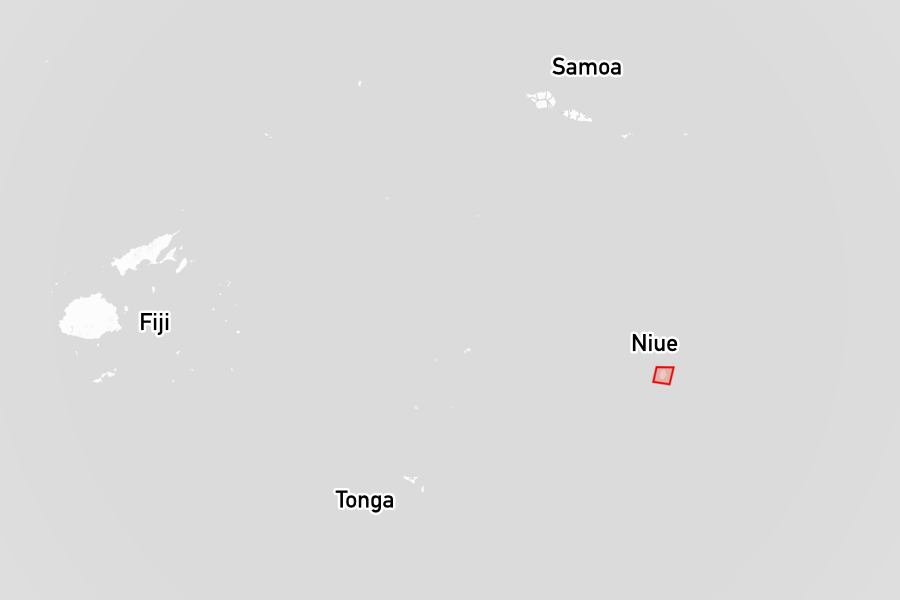
Niue is a very small raised coral island in the central South Pacific, lying between Tonga to the west and the Cook Islands to the east, with a population of around 1,800 people. The island rises steeply from the ocean with no lagoon or sheltered harbour, and visiting yachts use moorings off the main settlement of Alofi on the western coast. Niue is a self-governing state in free association with New Zealand.
Attractions
Niue's coastline is characterised by dramatic limestone formations, chasms, and sea caves accessible on foot from the main road. Underwater visibility in Niue is reputed to be among the best in the world, with up to 80 metres visibility. Scuba diving is popular but must be done with a local operator. The dive operator offers scuba dives and classes, spinner dolphin trips, and whale snorkelling trips in season.
A steep ladder descent through coral cliffs leads to the secluded sandy floor of Togo Chasm, which opens to the ocean at its base and is best visited at low tide. Avaiki Cave is a large multi-level limestone cave with a tidal pool, stalactites, and natural light filtering through the rock. The pool is swimmable at low tide.
A walk through forest and a cave system on the island's northern coast leads to Talava Arches, where a coral arch spans above the reef. On the northwest coast, Matapa Chasm is a sheltered swimming hole where freshwater meets seawater in a narrow limestone channel, a short walk from the road.
Places to stay
Below are the most popular and highly rated places to stay, based on reviews from the noforeignland community:
Moorings

|
Alofi Bay
★
4.3
Mooring buoys are in very good condition and provide solid shelter from northeastern to southeastern winds. Though protection is limited against western winds, communication from local services is reliable. Visitors report positive experiences with locals and marine life nearby.
|
Yacht clearance links
Useful yacht clearance links:
- Noonsite: Clearance procedures, processes and fees.
- https://www.noonsite.com/place/niue/
Yacht clearance reviews
The following lists summarize noforeignland user reviews for clearing in at ports of entry and when using clearance agents in Niue:
Ports of entry offices
|
Alofi Bay Customs
★
5.0
Check-in at Alofi Bay Customs is efficient, taking around 10 minutes when paperwork is sent in advance. Staff interactions are positive, with helpful guidance provided about local information and specific procedures. However, customs clearance is unavailable on weekends.
Place details mention: check in steps, opening hours, prearrival requirements and fees or payments.
|
Notes for mariners
Daylight arrival is strongly recommended as the eastern coast has sudden coral walls and two unlit fish aggregation devices lie low in the water on the approach to Alofi Bay. The mooring field is sheltered from the prevailing south-easterly trades but is an open roadstead exposed to westerly swells, and vessels should leave the moorings and stand off or seek shelter on the eastern side of the island in strong westerly conditions. Anchoring is not possible due to water depth and fragile coral regrowth, and moorings managed by the Niue Yacht Club should be booked in advance.
Landing you dinghy on the wharf requires the dinghy to be lifted out using the electric wharf crane and then moved on a supplied small trolley away from the crane landing area. There is no beach to land on. The dighy cannot be left in the water tied to the dock.
Niue is a whale sanctuary with strict regulations on interactions with whales. Biosecurity restrictions prohibit landing food, plants, meat, eggs, and animal products without quarantine officer permission, and pets may not go ashore. Fishing, diving, and boating are not permitted on Sundays, with the exception of tender runs to the wharf.
Flights operate twice a week from Auckland so it is possible to change crew or import urgently needed parts.
The off-season
Niue lies on the main Pacific cruising route between the Cook Islands and Tonga and sees the majority of its yacht traffic during the May to October trade wind season. The island offers no cyclone shelter and no haul-out facilities, and the mooring field is closed during the cyclone season from November to April. Yachts departing Niue at the end of the season typically continue west to Tonga or Fiji before heading south to New Zealand for the cyclone season.
Facts for visitors
- Best times of year to sail here: May to October
- Most common type of shore power: 240V 50Hz (Australian/New Zealand-style three-pin plugs)
- Cost for provisioning: Medium
- Currency: New Zealand Dollar (NZD)
- Personal security: Generally considered safe with low crime rates
- Emergency phone numbers:
- Police: 999
- Ambulance: 999
- Fire: 999
- International dialing code: +683
- Time zone(s): UTC -11
Maritime history
Archaeological evidence indicates that Niue was first settled by Polynesian voyagers from Samoa around 900 AD, arriving in vaka, the double-hulled sailing canoes used across the Pacific. The island had no centralised government until around 1700, when a succession of patu-iki, or kings, emerged as rulers.
The first known European sighting was by Captain James Cook in 1774 during his second Pacific voyage. Cook made three attempts to land but was refused on each occasion by the inhabitants, and named the island Savage Island in consequence. Whaling vessels were among the most regular European visitors in the 1800s, with the first on record being the Fanny in February 1824. Missionary contact followed, and Christianity was established across the island by the mid-1800s. Britain established a protectorate over Niue in 1900, transferring administrative control to New Zealand the following year. Niue achieved self-government in free association with New Zealand in 1974.
In 2022, Niue designated its entire ocean territory as the Niue Nukutuluea Multiple-Use Marine Park, covering around 318,000 square kilometres. Within the park, 40% is a no-take protected area where fishing, seabed mining, and mineral exploration are prohibited. Niue is also a designated whale sanctuary, and humpback whales are frequently seen in its waters during their annual migration between July and October.