
Italy
Last updated: 9 April 2026
At a glance
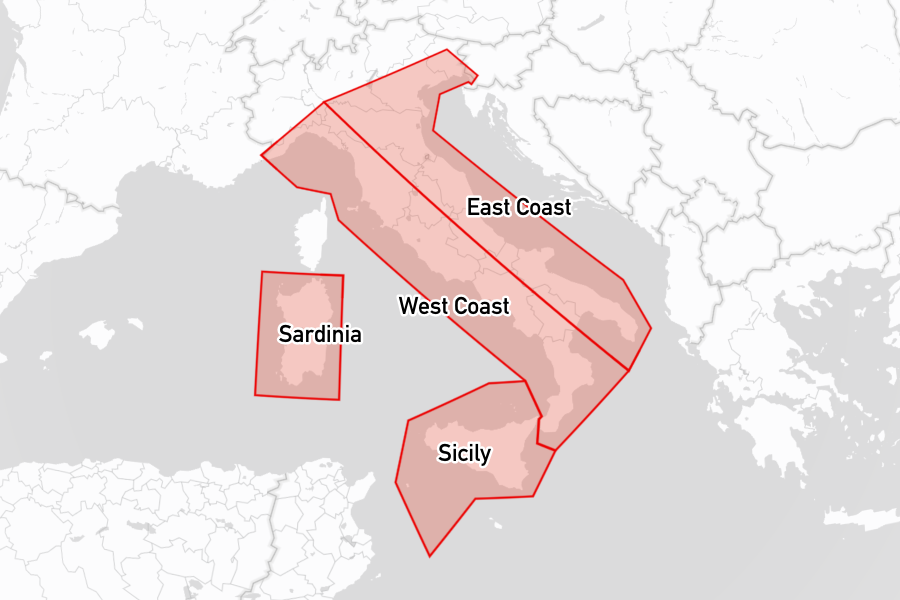
Italy offers four distinct cruising areas: the west coast from the French border south to Calabria, the Adriatic coast, Sardinia, and Sicily. Each has a markedly different character, and together they make Italy both a destination in its own right and a staging point for passages across the Mediterranean. Marinas, haulout yards, and provisioning are widely available throughout.
Explore sailing areas
Our sailing area guides contain the most useful information for cruisers, including top-rated places to stay, attractions, yacht services, and summaries of yacht clearance experiences.
- Sardinia Sailors often visit for its secluded coves and rich marine biodiversity.
- Sicily and Southern Islands Offers a blend of vibrant culture and varied sailing experiences.
- West Coast Renowned for its dramatic coastline and charming port towns.
- East Coast Features bustling cities and picturesque anchorages along the Adriatic Sea.
Yacht clearance and notes for mariners
See the relevant sailing area page above for details.
The off-season
Many Italian marinas offer liveaboard sailors accommodation during the winter. Some notable options include: Marina di Ragusa and Marina di Cala del Sole (Licata) in Sicily, Gaeta on the west coast, Marina di Roccella in the south, and Venezia Certosa Marina in Venice. Further afield, Monastir Cap Marina in Tunisia is a popular wintering base for boats needing a break from the Schengen zone.
Facts for visitors
- Best times of year to sail here: May to October
- Most common type of shore power: 230V 50Hz
- Cost for provisioning: Medium
- Currency: Euro (EUR)
- Personal security: Generally safe for visitors; petty theft is the most common concern in larger towns and cities
- Emergency phone numbers:
- Police: 113
- Ambulance: 118
- Fire: 115
- Coast Guard: 1530
- International dialing code: +39
- Time zone(s): UTC+1 (UTC+2 in summer)
Maritime history
The Phoenicians and Greeks established coastal trading settlements along the Italian peninsula from the 8th century BC, and the Etruscans operated an active maritime trade along the Tyrrhenian coast before Roman expansion absorbed them. At its height, Rome exercised control over the entire Mediterranean basin, referring to it as Mare Nostrum, and maintained the naval infrastructure to protect its trade routes and project military power across it.
After Rome's decline, maritime power concentrated in the city-states. Venice, Genoa, Pisa, and Amalfi built seaborne commercial empires between the 9th and 15th centuries, competing for eastern Mediterranean trade routes and establishing colonies across the Aegean and the Levant. Christopher Columbus, Amerigo Vespucci, and John Cabot were all from the Italian peninsula. The Battle of Lepanto in 1571, fought in the Gulf of Patras between a Holy League fleet and the Ottoman Empire, involved substantial Venetian and Genoese forces and ended Ottoman naval dominance in the central Mediterranean.
Following unification in 1861, Italy developed a modern naval force that saw action in both World Wars. Today the country is a major centre for superyacht construction and refit, with yards concentrated around Viareggio, La Spezia, and the Adriatic coast.